



We incorporate outings to the countryside, choosing terrain with areas uphill and areas downhill, which will prepare our muscles for the pilgrimage
Training needs
Recommended routines and exercises before starting the Camino
In order to travel the Camino on foot, the time assigned to previous training is very important.

If the pilgrim chooses to travel the Camino on foot, the stages which we plan could involve about 25 to 30 kilometres daily, therefore, the effort we put into previous training will be very important. This must consist of daily walks which will be progressively increased as regards distance and intensity. We will begin with short strolls on flat land and, progressively, we will increase the number of kilometres and vary the type of terrain in order to adapt our bodies to what we are going to find on the Camino and to the stages we have planned.
We will begin with short strolls on flat land and, progressively, we will increase the number of kilometres and vary the type of terrain in order to adapt our bodies to what we are going to find on the Camino
As we make progress in this training, we incorporate outings to the countryside, choosing terrain with areas uphill and areas downhill, which will prepare our muscles for the pilgrimage.
It is also advisable that, in the final training phase, we try to walk with the backpack loaded in order to observe the resistance of our bodies, and, if the weight is excessive in order to accustom ourselves to this component as this may condition walking.
In the cases in which it is not possible to previously prepare, making contact with the Camino must be smooth, therefore exertions will be minimised in the first stages and the intensity will be gradually increased as suits our capacities.
+ Information
Documents
- Guidelines for the Camino (only in Castilian Spanish) PDF / 801 KB
- Physiotherapy on the Camino (only in Castilian Spanish) PDF / 1401 KB
Preparation and advice regarding footwear
It is preferable to choose boots which secure the ankles in order to prevent injuries.
The footwear for going on this type of walk must have been already used and adapted to the feet. It is inadvisable to use new footwear as it will surely lead to chaffing and blisters. Trekking or mountain boots are described as the most suitable for this activity, but, if the summer is the season chosen, in order to mitigate the heat, trainers may be used. In any case, it is always preferable to choose boots which better secure the ankles in order to prevent injuries. There are also summer boots which are fresher, lighter and transpire.
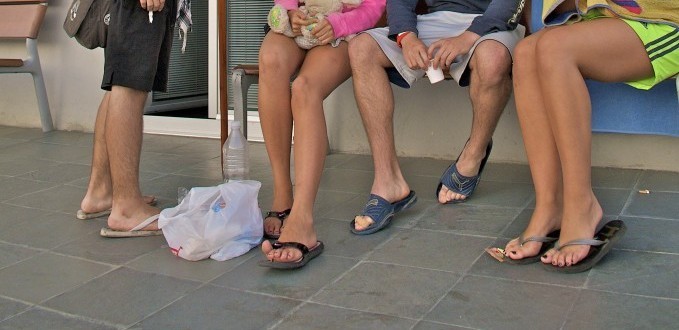
When choosing footwear, this must have a hard sole and must not have a heel which is too soft as this could lead to injuries
When choosing footwear, this must have a hard sole and must not have a heel which is too soft as this could lead to injuries, for example in the Achilles tendon. Although the boots must secure the ankles, it is not advisable that they put on too much pressure as this would be counterproductive. It is important to choose boots with a reduction in the back part of the boot leg.
We can also incorporate other types of footwear for the rest periods: slippers, sandals or flip-flops are good options for relaxing and refreshing feet which are tired after their exertions.
Advice and recommendations if you are carrying a backpack
The backpack must be adapted to the contour of the back so that we can maintain correct body posture.
The backpack must not be worn too loosely nor excessively tightly. It must be adapted to the contour of the back so that we can maintain correct body posture. In order to achieve a comfortable position, it must be placed in such a way that its weight is near the axis of the body and its centre of gravity.

In order to achieve a comfortable position, it must be placed in such a way that its weight is near the axis of the body and its centre of gravity. Moreover, it will be positioned depending on the terrain being travelled on
Moreover, it will be positioned depending on the terrain: thus, going up steep hills means that it will be necessary to loosen the waist strap in order to facilitate breathing, however, while going downhill, it will be tightened a little more at the waist in order to rest the shoulders and not put pressure on them.
Advice for strengthening the leg muscles
It is necessary to train and do stretching and warm up exercises.
In order to strengthen the leg muscles, calves, quadriceps and hamstrings, it is necessary to train and do the stretching and warm up exercises before each stage.

Stretching the calves is one of the most recommendable activities before beginning and concluding each stage
For example, in order to stretch the calves properly, we can lean our hands against the wall and gradually fully lower the soles of the feet until we start to notice a certain tension in the backs of the knees.
How to prepare knees, tendons and feet
It is necessary to adapt walking to the different types of terrain.
In order to prepare knees tendons and feet, it is important to adapt walking to the different types of terrain. Thus, on a flat surface, the length of the step will be normal; on going uphill, we can take shorter, slower steps in order to avoid excess exertion. In the stages with prolonged uphill stretches, it is very important to support the complete sole of the foot on the ground in order to prevent excess muscular load. Long rapid steps are reserved for going downhill, but the type of terrain must be taken into account before speeding up the steps. Going downhill, part of the work falls on the heels, therefore, it will be necessary “to stamp” them properly on the ground, without forcing them so as to prevent injuries.
One point which is very important concerning avoiding injury is the use of a staff (stick or cane) which will serve as an aid to support us on difficult terrain and even to probe the stability of the route. The support of the staff can prevent the appearance of tendinitis.
One point which is very important concerning avoiding injury is the use of a staff (stick or cane) which will serve as an aid to support us on difficult terrain and even to probe the stability of the route. The support of the staff can prevent the appearance of tendinitis.
Excess exertions or incorrect postures can lead to injuries which hinder progress on the Camino. It is advisable to resort to a physiotherapist if this possibility exists so that he might evaluate the extent of the injury and the advisable treatment.
Some of the most common injuries among the pilgrims are tendinitis, sprains and traumatic arthritis. This arthritis affects the lower limbs most and sometimes microtraumas occur in the joints and these end up generating a clinical profile involving pain and inflammation. For example, after steep, prolonged descents, as in the area of Triacastela, on the French Camino, the knees suffer most and show signs of these exertions. Moreover, if we add long stages and the weight carried each day to a steep descent, there will be a greater risk of excess loading, and injuries to the knees.
Therefore, it is fundamental to plan the stages depending also on the type of terrain to be travelled through. So, in stages with long, continual slopes, it is preferable to reduce the number of kilometres we walk, free ourselves of excessive weight and correctly measure out our exertions. With adequate care using anti-inflammatories and cold applied locally, traumatic arthritis need not be an inconvenience to continuing on the route; but it is essential to continue with the “preventive” techniques described above.
TENDINITIS
Another common injury is tendinitis. This is described as a pulled muscle and can cause the breakage of fibres. It usually appears when several kilometres of the Camino have accumulated. In order to reduce the inflammation and pain, it is advisable to apply ice to the area; a piece of paper or cloth must always be placed between the skin and the ice in order to prevent burns. When the intensity of the pain increases, an analgesic (such as paracetamol) can be administered and an anti-inflammatory ointment applied. If the inflammation persists, it is advisable to take an anti-inflammatory, administered on a full stomach.
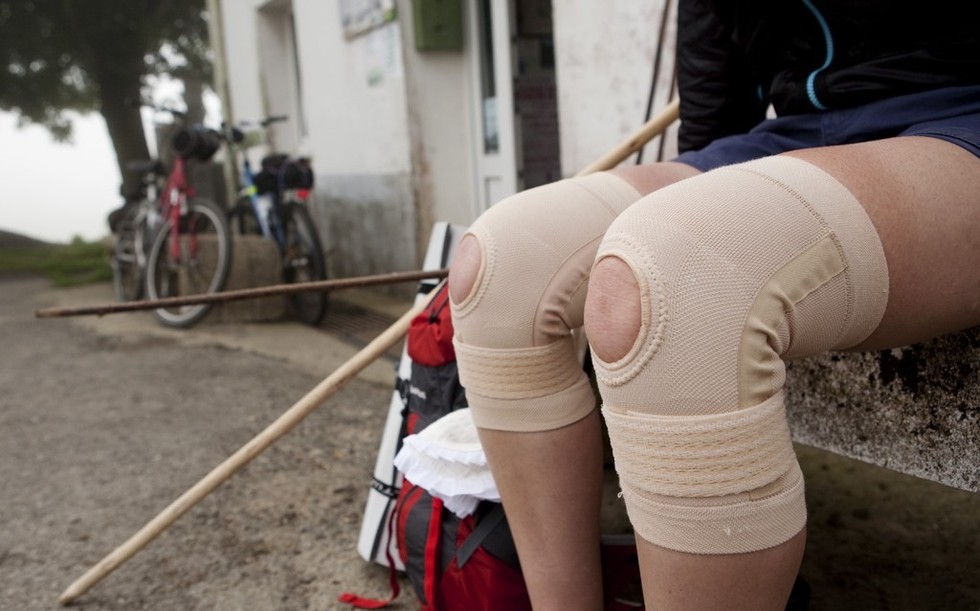
Support bandages will be used in cases in which there are small breakages of fibres, always consulting a doctor and a physiotherapist, who can evaluate the possibilities of addressing the rest of the Camino
Support bandages will be used in cases in which there are small breakages of fibres, always consulting a doctor and a physiotherapist, who can evaluate the possibilities of addressing the rest of the Camino.
A type of very frequent tendinitis among the pilgrims is one that occurs in the Achilles tendon, which affects the upper part of the heel and may become very painful. Some of the reasons which cause this and have to be avoided, insofar as this is possible, are walking for prolonged periods of time uphill and using inadequate footwear. Footwear which is fitted too tightly to the heel, as it will directly put pressure on the tendon, and heel pads which are too soft. It is advisable to use hard soles, with no air systems or cushioning on the heel and, in the event that boots are used, the back of the leg of the boot must be lowered.
In order to minimise the risk of injuring the Achilles tendon, during the previous preparation or training for the Camino, it is necessary to remember to do exercises which benefit the stretching of this tendon, always increasing the intensity progressively. This is fundamental in the case of women who usually wear high heel shoes in their daily lives and this means that the heel is accustomed to minimum stretching, thus, this type of tendinitis mainly derives from the difference in the height of the heel we wear as the change to flat footwear causes a greater lengthening of the tendon which is more marked in the uphill stretches.
It is normal that the annoyance or pain begins in the morning and may disappear during the walk and return more intensely at the end of the stage, sometimes it can hinder walking as it becomes permanent. In order to alleviate the pain, ice can be applied and anti-inflammatories administered with medical supervision. A visit to a physiotherapist is advisable in order to treat the pain caused by this type of tendinitis.
ANKLE SPRAINS
During the walk, sprains may also occur which affect the joints and are sometimes caused by excessive lengthening or even by a breakage of the ligaments. The commonest of these is the ankle sprain, generally the result of incorrectly placing the foot on the ground. Walking on irregular or stony terrain may lead to these injuries, especially on slopes.
In order to minimise the risk of injury to the Achilles tendon, during the previous preparation or training for the Camino, it is necessary to remember to do exercises which benefit the stretching of this tendon, always increasing the intensity progressively
Again it is important to avoid excess weight as an excessive load can cause the breakage of a ligament, which would mean an aggravation of the injury. The type of footwear is also fundamental so as to avoid these mishaps, so, it is preferable to use boots which secure the ankle but do not apply excessive pressure.
As regards the treatment of this injury, it is necessary to distinguish between the simple sprain and a sprain with partially or totally broken ligaments. For the simple sprain, it is sufficient to apply ice locally and rest for two days, however, when there is a breakage, in no case can the walk be continued, we will be irremediably obliged to abandon the pilgrimage.
Recommendations regarding the preparation to go on the Camino by bicycle
As in other modalities, training must go from less to more little by little.
As in other modalities, training must go from less to more little by little. At the beginning, travelling will be done on flat terrain with no difficulties and, as progress is made in the preparation, routes which alternate flat parts and parts uphill will be used; in this way you will become familiar with the bicycle and can determine the most adequate use of the plate and sprocket for each one.
At the beginning, travelling will be done on flat terrain with no difficulties and, as progress is made in the preparation, routes which alternate flat parts and parts uphill will be used
As regards both walking and cycling, the last days of preparation must be assigned to observing how we perform with weight, so, it is advisable to incorporate loaded panniers for the daily journeys. This measure also serves to accustom ourselves to the load and size and to maintain stability. In the case of cycling, it is advisable to reduce the weight to the minimum, taking only what is really essential.